
About this specimen
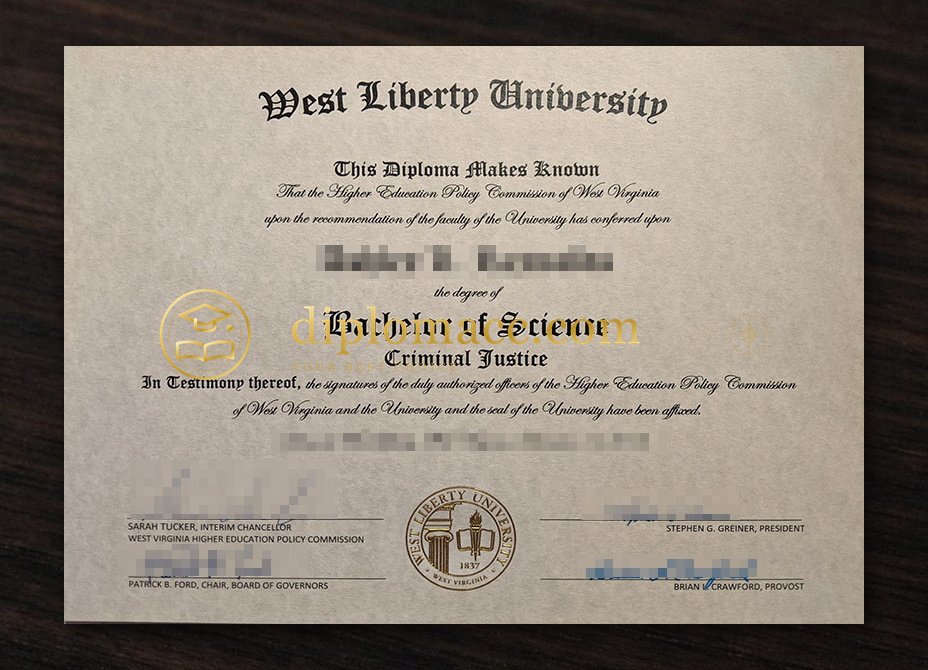
The paper substrate of a West Liberty University diploma is a security-grade stock whose physical properties are fixed before any printing or finishing occurs. The document is produced in a standard 8 1/2 by 11 inch format, a size that provides sufficient field for the formal text block, the ornamental border, and the seal area without compressing any element. The sheet is formulated as an optically dull paper, containing no optical brightening agents that would fluoresce under ultraviolet illumination, so that any covert security fibres or chemical additives introduced into the furnish remain readable without background interference. The fibre blend is selected for dimensional stability and for the capacity to accept a mechanically deformed seal without fracturing at the impression zone. The stock is typically a heavyweight certificate grade that holds a crisp edge under handling and distinguishes itself from ordinary office paper by its firmer, slightly textured handle.#West Liberty University dipolma West Liberty University degree West Liberty University certificate.
The watermark in diploma paper of this class is formed during sheet consolidation on a cylinder mould machine rather than applied as a subsequent surface image. A wire-mesh mould cover carrying the watermark design rotates through a vat of refined stock; as water drains through the mesh, fibres deposit differentially according to the porosity of the cover, creating a density variation that is continuous with the fibre matrix of the sheet. This method can render the watermark as a multi-tonal, sculpted image with graded light and dark zones, rather than a flat silhouette, and because the mark is structural it cannot be reproduced by printing, scanning, or photocopying. The watermark is read by transmitted light, where the thinner fibre zones appear lighter and the denser zones appear darker, producing a three-dimensional effect that vanishes under reflected light alone.
- Buying a West Liberty University diploma.
The printed surface of the diploma carries a complementary layer of fine-line and micro-scale texture that is independent of the paper’s internal structure. Microtext may be embedded within the border or background at character heights below the resolution of the unaided eye, so that the lettering remains crisp under magnification but degrades into a continuous line or a blurred texture when photocopied. The printing may also incorporate a guilloche or iris-print technique, in which pale shades of colour fade into one another through an advanced offset process, creating a surface that is difficult to replicate with ordinary digital equipment. These printed features sit on the surface of the sheet, yet they function as an authentication layer that verifies the printing origination independently of the paper’s internal watermark.
The official seal on the West Liberty University diploma is realized as a foil-embossed element, a construction that introduces a three-dimensional component no flat printing process can reproduce. The seal is applied through a die-stamping operation: a metallic foil layer is positioned over the paper, and a heated die bearing the seal design in relief is pressed against a matching counter-die, simultaneously bonding the reflective foil to the surface and compressing the paper fibres into a bas-relief topography. The university’s black and gold colour identity is carried into the diploma finish, and the gold embossed treatment of the institutional name or seal is a documented feature of the diploma’s presentation. The finished seal therefore combines two physical properties: the angle-dependent reflectivity of the foil layer and the tactile relief of the die impression, with the crest or emblem standing above the surrounding field and remaining legible in raking light even where the foil itself is not directly visible.
The authenticity of the diploma as a physical object resides in the layered interaction of these processes rather than in any single feature. The optically dull security paper with its cylinder-mould watermark establishes the sheet as a controlled material; the microtext and iris-print surface establish the graphic as originating from a security printing environment; and the foil-embossed seal establishes a mechanical deformation that cannot be lifted or transferred intact from one document to another. The paper may also carry chemical protection against erasure, so that any attempt to lift or modify printed information leaves a localised stain or discolouration rather than a clean surface. A photocopy or digital scan may capture the visible layout and the outline of the seal, but it will fail to reproduce the transmitted-light watermark, the tactile relief of the die-struck foil, and the fine-line integrity of the security pattern, leaving the physical sheet as the only carrier of the complete set of authenticating signals.